The Coursework of Creating: A Conversation with Visual Artist Griffin Goodman
Griffin Goodman is a Chicago-based visual artist whose work feels like a fever dream of childhood nostalgia and pop culture in the best possible way. When I first walked into Goodman's studio, I felt like I was meeting a modern day Andy Warhol which is fitting considering Goodman himself describes his work as "kind of a mashup of Andy Warhol and Where's Waldo." It's a perfect description for an artist whose practice is built on remixing, sampling, and reimagining — taking cartoon characters and old memories and using them to tell entirely new stories.

Hotel Room #5, 2026, 48 X 42 in, acrylic and colored pencil on panel
From Tennis Courts to Art Studios
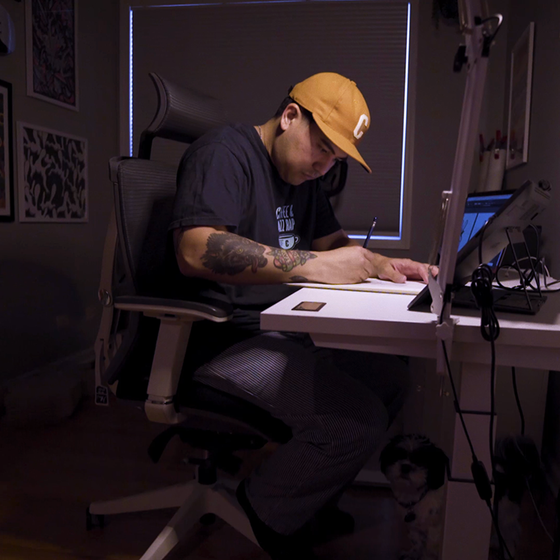
Like many artists, Goodman didn't arrive at his path in a straight line. He originally had his sights set on tennis, but a turning point came during his senior year of high school. An AP art class changed everything. "That kind of solidified my love for art," he recalls. From there, he started painting and sharing his work on social media.
When Goodman began sharing his work on Twitter, the response was immediate. He painted a portrait of Pharrell Williams, who then followed him back. "I was like, I gotta keep going with this," Goodman says. That early validation wasn't just flattering — it was fuel.
Sampling the Past to Build the Future
Goodman's work is deeply rooted in art history. He counts Walt Disney, Robert Crumb, and Nicole Eisenman among his biggest influences, and he approaches his practice the way a musician approaches a record — sampling the greats, remixing their energy, and creating something distinctly his own.
"The work is heavily influenced by the artists that came before me," he says. "I love art history." That reverence for the past doesn't hold him back, though. It propels him forward, giving him a foundation from which to build his own visual narrative.

The Grateful Daydream Dead Doodler, 2024, 48 x 60 in, acrylic on canvas
A Highlight Reel Worth Rewinding
The highlights have been coming fast. Goodman has collaborated with the Chicago Bulls and Warner Brothers on animation cells — milestones that still feel surreal to look back on. He was also nominated for Forbes 30 Under 30, which he describes modestly as "a huge accomplishment."
Still, he keeps his eyes forward. "I continually look back, but I'm also always looking forward to the next thing."
The Legacy Question
When asked about legacy, Goodman doesn't hesitate — but he also doesn't overcomplicate it. "The biggest legacy is just the art speaking for itself," he says. He hopes his work lives on long after he's gone and, more than anything, that it inspires the next generation of artists to pick up their own tools and make something.

Mr. Pickels, Spam, and Cosmic Interference, 2025, 19 x 24 in acrylic, colored pencil, wax, and graphite on paper
What "Coursework" Really Means
For Goodman, the word coursework carries real weight. It's not just a brand — it's a philosophy. "Coursework to me is just the process of making," he explains. "It is just like the coursework that we as creatives and artists just deal with — creating, making, remixing, sampling. That's the coursework."
It's a grounding idea: that art isn't about the finished product alone, but about the ongoing, everyday practice of showing up and doing the work. For Griffin Goodman, that practice is the point.